


An Editorial Note on a South African botanical, its phytochemistry, and how it supports summer-stressed skin.

Honeybush is one of the most important botanicals in the South African skincare tradition, and one of the least recognized in modern skincare formulation. That gap — between the ingredient's genuine value and its market profile — is worth closing.
The plant — Cyclopia intermedia and its close relative Cyclopia genistoides — grows only in the Cape Floristic Region, a small strip of the Western Cape where it has been used medicinally for centuries and cultivated commercially for tea for decades. Its skincare significance is more recent, and it comes from a phytochemical profile that overlaps meaningfully with the compounds skin needs most in summer.
The relevant chemistry is the polyphenol library. Honeybush is unusually rich in mangiferin — a xanthonoid compound with well-documented antioxidant activity in dermatological research — and hesperidin, a flavonoid that supports vascular integrity and skin comfort. Both compounds are concentrated in the leaves and stems of the plant, and both are extracted into the water-soluble fraction used in skincare formulations. Honeybush also contains isoflavones and a range of proanthocyanidins that contribute to its broader antioxidant profile.
What this profile does in skin: Honeybush contributes to the skin's response to environmental stress. Its polyphenols intercept free radicals produced by ultraviolet exposure. Its flavonoids support the microcirculation of the dermis, which is often compromised in reactive skin. Its isoflavones contribute to skin comfort and balance, particularly in skin experiencing seasonal reactivity.
The summer application follows from the chemistry. Skin under sustained light exposure produces oxidative stress that persists for days after exposure ends. That stress manifests as redness, sensitivity, and reactivity — the visible register of a biological response still unfolding beneath the surface. Botanicals rich in polyphenols, particularly mangiferin-rich botanicals like Honeybush, work alongside skin during this response. Not by suppressing it, but by supporting the tissue while the response runs its course.
Honeybush is also one of the botanicals where AB's sourcing philosophy is most visible. The plant is endemic to South Africa, cultivated by small-scale growers in the Cape, and legally protected under South African biodiversity regulations. Every Cyclopia extract in AB formulations is sourced through suppliers who comply with the Nagoya Protocol on access and benefit-sharing — a genuine constraint that most global skincare brands sourcing generic "plant extracts" do not observe.
Across the range, Honeybush appears in formulations built around skin recovery, comfort, and equilibrium:
Advanced Vitamin C + Multi-Peptides Serum. Cyclopia genistoides leaf extract works within the serum's stabilized vitamin C, multi-peptide, and antioxidant architecture — alongside Superoxide Dismutase, Ferulic Acid, and Resveratrol — contributing to the treatment's comprehensive antioxidant profile.
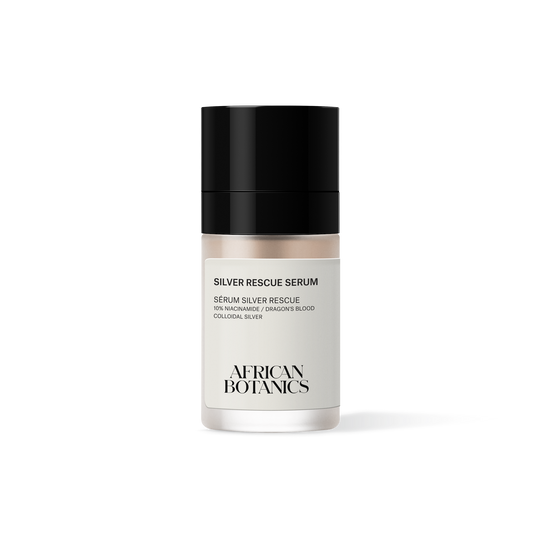
Silver Rescue Serum. Cyclopia intermedia leaf extract works alongside colloidal silver, Resurrection Plant, and a botanical library of soothing actives — Calendula, Arnica, Marshmallow — in a serum formulated to support skin recovering from reactivity and sustained exposure.
Micro-Hydration Activator Mist. Cyclopia genistoides leaf extract sits within a lightweight mist formulated to refresh and rebalance skin throughout the day, particularly in summer conditions.
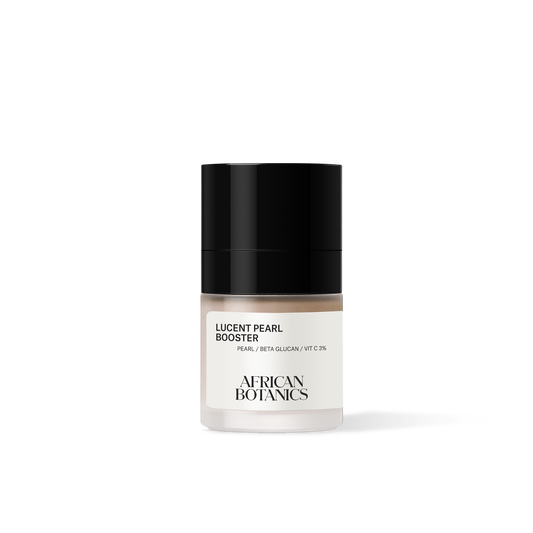
Lucent Pearl Booster. Cyclopia intermedia leaf extract works with the Booster's peptide-and-vitamin-C architecture, contributing to the treatment's tone-supporting and comfort-supporting profile.
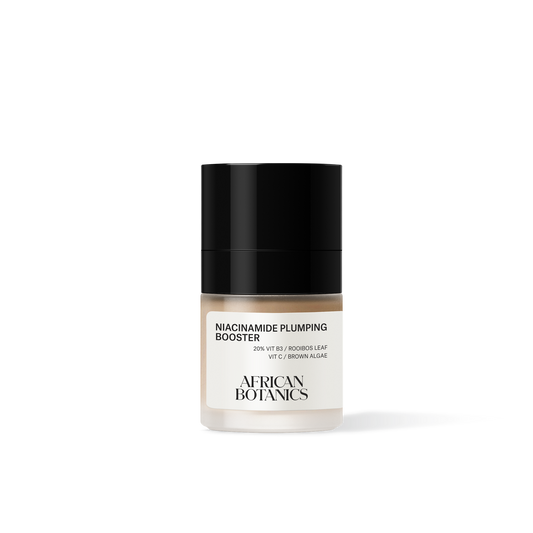
Niacinamide Plumping Booster. Cyclopia genistoides leaf extract joins niacinamide, plant-derived collagen, and 3% Sodium Ascorbyl Phosphate in a treatment formulated for skin experiencing seasonal reactivity.
Honeybush deserves to be recognized in the same category as vitamin C, peptides, and the biotech actives that dominate the current conversation. Its polyphenol content — mangiferin, hesperidin, isoflavones — supports skin through the specific stresses of summer with a chemistry that no synthetic active can replicate. That is exactly why it belongs in the AB library — and why it belongs in your ritual.
ON THE SCIENCE
Joubert, E., Joubert, M. E., Bester, C., de Beer, D., & De Lange, J. H. (2011). Honeybush (Cyclopia spp.): From local cottage industry to global markets — The catalytic and supporting role of research. South African Journal of Botany, 77(4), 887–907.
Beelders, T., de Beer, D., Ferreira, D., Kidd, M., & Joubert, E. (2018). Sensory-directed selection of chemical markers of Cyclopia genistoides for consumer-oriented product improvement. Journal of the Science of Food and Agriculture, 98(4), 1516–1524.
Petrova, A., Davids, L. M., Rautenbach, F., & Marnewick, J. L. (2011). Photoprotection by honeybush extracts, hesperidin and mangiferin against UVB-induced skin damage in SKH-1 mice. Journal of Photochemistry and Photobiology B: Biology, 103(2), 126–139.
Magcwebeba, T. U., Riedel, S., Swanevelder, S., Bouic, P., Swart, P., & Gelderblom, W. (2016). Interleukin-1α induction in human keratinocytes (HaCaT): An in vitro model for chemoprevention in skin. Journal of Skin Cancer, 2016, 6234321.