


An Editorial Note on formulation compatibility, layering order, and what actually determines whether the combination works.

Yes. Vitamin C and peptides can be layered together, and in most modern formulations they are designed to work in combination rather than opposition.
The concern that circulates online — that vitamin C's acidic pH destabilizes peptides on contact — is dated. It applies specifically to older L-ascorbic acid formulations at pH values below 3.5, which do compromise certain peptide structures. Contemporary vitamin C derivatives, particularly tetrahexyldecyl ascorbate and ethylated ascorbic acid, are stable at higher pH values and do not degrade the peptide systems used in current-generation skincare. The question of compatibility was resolved by the chemistry roughly a decade ago. What persists is the outdated advice.
The more useful question is why the combination is worth building in the first place.
Vitamin C and peptides address two different phases of the same problem. Vitamin C is an antioxidant — it intercepts free radicals produced by ultraviolet exposure before they oxidize cellular structures. Its work is protective and interceptive; it addresses damage as it happens or shortly after. Peptides are signaling molecules. They cue the skin's repair machinery — collagen synthesis, fibroblast activity, matrix reorganization — to respond to damage that has already occurred. Vitamin C protects and intercepts; peptides instruct and rebuild. In combination, they cover both sides of the damage response.
Layered together, they compound. Vitamin C reduces the oxidative burden that would otherwise consume the skin's repair resources; peptides then direct those resources toward structural rebuilding. Neither active does the other's work. Both are more effective in the presence of the other.
A note on terminology. Peptides in modern skincare formulation encompass a broader category than the original synthetic signaling peptides. The term now includes botanical protein hydrolysates such as glutaminated oligopeptides derived from lupin, pea, and millet, as well as plant-derived collagen fragments.
Both synthetic and botanical peptides cue the same regenerative response at the cellular level. What matters is the mechanism, not the molecular origin.
African Botanics has been formulating vitamin C and peptides together across the range since well before the current market conversation. The pairing is not a recent innovation for the brand — it is a foundational formulation philosophy that predates the category's current interest in either active. Multiple treatments across the range are built around the combination.
The formulation implication is that what matters is not whether vitamin C and peptides share a bottle, but whether both are delivered at full stability and bioactivity. A stable vitamin C paired with a properly formulated peptide treatment will perform whether they share a formulation or sit in separate ones. What determines the outcome is the quality of each, not the delivery method.
The compatibility question, in the end, is not really about whether the two actives can be used together. It is about whether the formulation architecture supports both doing their work at full strength. A vitamin C that has oxidized on the shelf, or a peptide system compromised by pH, is compatible with nothing. What matters is stability — whether both actives share a bottle or arrive from two.
AFRICAN BOTANICS FORMULATIONS BUILT AROUND THIS PAIRING
Advanced Vitamin C + Multi-Peptides Serum. A 20% stabilized vitamin C complex delivered alongside a multi-peptide system including Bio-Optimized Hexapeptide P6, formulated as the most concentrated expression of the pairing in the range.
Firming + Lifting Collagen Activator Serum. A bio-active peptide system paired with regenerative botanicals to support collagen synthesis. Designed for evening application.
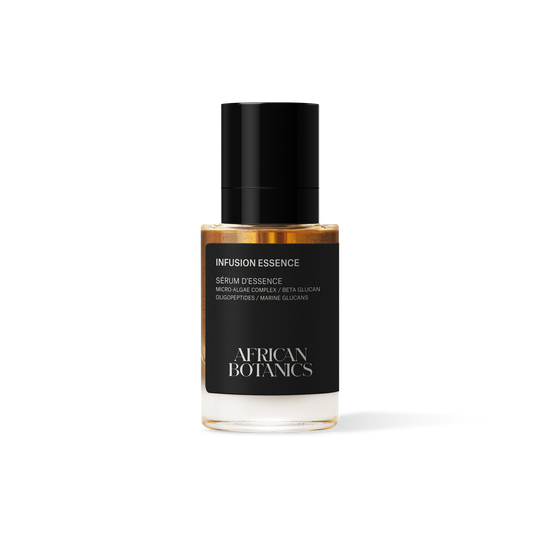
Infusion Essence. A hydrating treatment essence built around glutaminated oligopeptides derived from lupin, pea, and millet, delivered with Ascorbyl Palmitate — a lipid-soluble vitamin C — and a botanical library including Myrothamnus flabellifolius and Coenzyme Q10. Formulated to prime skin for subsequent layers.
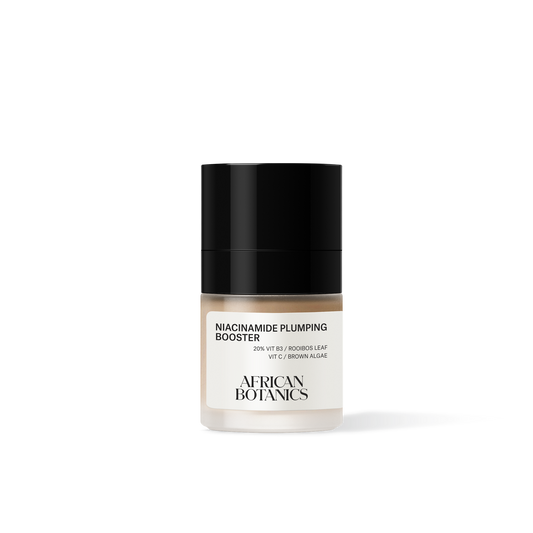
Niacinamide Plumping Booster. A niacinamide concentrate formulated with plant-derived collagen, Lactobacillus ferment lysate, and 3% Sodium Ascorbyl Phosphate — a stable water-soluble vitamin C. For targeted use or ritual layering.
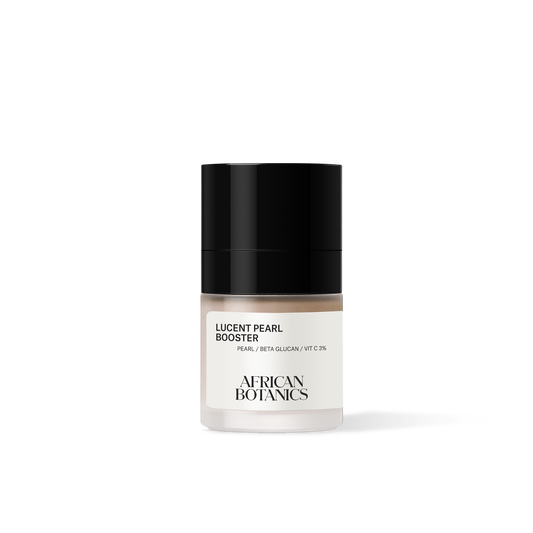
Lucent Pearl Booster. A treatment formulated around a botanical peptide complex — hydrolyzed lupine, pea, and millet — with 3% Sodium Ascorbyl Phosphate, Mother of Pearl, Ceramides, and Coenzyme Q10. For luminosity and even tone, applied for targeted use or as a ritual layer.
ON THE SCIENCE
Al-Niaimi, F., & Chiang, N. Y. Z. (2017). Topical Vitamin C and the Skin: Mechanisms of Action and Clinical Applications. Journal of Clinical and Aesthetic Dermatology, 10(7), 14–17.
Reilly, D. M., & Lozano, J. (2021). Skin collagen through the lifestages: importance for skin health and beauty. Plastic and Aesthetic Research, 8, 2.
Schagen, S. K. (2017). Topical Peptide Treatments with Effective Anti-Aging Results. Cosmetics, 4(2), 16.
Pinnell, S. R. (2003). Cutaneous photodamage, oxidative stress, and topical antioxidant protection. Journal of the American Academy of Dermatology, 48(1), 1–19.
