



The Science of Skin Structure, Signaling and Visible Longevity

The future of advanced skincare is increasingly defined by precision: the ability to identify specific biological processes, develop ingredients with targeted functions and integrate them into formulations designed to work with the skin's physiology.
Peptides occupy an important position in this evolution.
Once discussed primarily as collagen-supporting ingredients, they now represent a diverse field of molecular technologies. Advances in peptide engineering, sequence design and delivery systems have introduced more sophisticated approaches to addressing the visible consequences of skin aging.
Yet the distinction between one peptide and another is rarely explained. A formula containing several peptides is not necessarily more advanced than one built around a carefully selected sequence. Molecular structure, biological activity, stability and compatibility with the surrounding formulation all influence its potential.
To understand precision peptides is to look beyond the ingredient name and examine the science of skin structure itself.
The Biology of Skin Firmness
The Extracellular Matrix: Where Skin Structure Begins
Skin firmness depends on a complex network of structural proteins, specialized cells and molecules that regulate hydration and tissue organization.
Within the dermis, fibroblasts are responsible for producing and maintaining components of the extracellular matrix, including collagen, elastin and glycosaminoglycans.
Collagen provides tensile strength. Elastin contributes to the skin's capacity to return to its original shape after movement. Hyaluronic acid and other matrix-associated molecules help maintain hydration and the physical environment surrounding these structural proteins.
These components are not static. The extracellular matrix undergoes continuous remodeling, governed by the relationship between synthesis, degradation and cellular communication.
With age, this balance changes.
Fibroblast activity becomes less efficient. Collagen fibers become increasingly fragmented, while cumulative exposure to ultraviolet radiation and oxidative stress contributes to changes in matrix organization. Enzymes known as matrix metalloproteinases participate in the degradation of extracellular proteins, a necessary biological function that can become dysregulated during photoaging.
The visible consequences include reduced elasticity, diminished firmness, fine lines and changes in skin texture.
Importantly, the appearance of aging does not arise from collagen loss alone. It reflects interconnected changes in cellular activity, structural organization, moisture regulation and the skin's ability to maintain its protective barrier.
This understanding has influenced the development of contemporary peptide technologies.
"Skin firmness is not determined by the presence of collagen alone, but by the integrity of the biological systems that maintain it."
The Science of Molecular Signaling
What Makes a Peptide Precise?
Peptides are short chains of amino acids connected by peptide bonds. Their biological properties depend on several factors, including amino acid sequence, molecular configuration and chemical modification.
In the body, certain peptides participate in communication between cells and tissues. Some function as signaling molecules, while others arise naturally during the breakdown and remodeling of structural proteins.
Cosmetic peptide research draws on these biological principles.
Among the most extensively investigated are signal peptides, developed to interact with pathways associated with extracellular matrix maintenance.
A particular area of interest involves matrikines—biologically active peptide fragments derived from extracellular matrix proteins. During tissue remodeling, some of these fragments can participate in signaling processes that influence cellular behavior.
This has provided a scientific basis for investigating synthetic peptide sequences designed to resemble or interact with aspects of naturally occurring signaling systems.
However, a peptide's proposed biological mechanism does not automatically establish its effectiveness when applied to the skin. Its activity must be considered alongside concentration, delivery and the quality of the available clinical evidence.
Sequence-Specific Peptide Engineering
One of the more significant developments in cosmetic biotechnology is the design of peptides with defined amino acid sequences selected for particular biological properties.
A hexapeptide, for example, consists of six amino acids. A tetrapeptide contains four, while a tripeptide contains three.
These classifications describe molecular length, not performance.
Two peptides of identical length can have entirely different structures and proposed functions.
Contemporary peptide engineering investigates how sequence design and molecular modification may influence interactions with biological targets.
Some peptides are developed in relation to collagen-associated signaling. Others are studied for their potential effects on extracellular matrix components, surface texture or the appearance of wrinkles.
The objective is greater functional specificity—not simply a higher number of peptides within a formula.
The New Generation of Peptide Technologies
Collagen-Inspired Hexapeptides
One area of biotechnology research involves peptide sequences designed with reference to structural characteristics of human collagen.
These technologies investigate whether carefully selected amino acid arrangements can influence pathways associated with extracellular matrix maintenance.
Certain collagen-inspired hexapeptides have been studied for their effects on procollagen-related markers and hyaluronic acid production in laboratory models.
An additional technological consideration is encapsulation.
By incorporating peptides into lipid-based delivery structures, formulators can seek to improve ingredient stability and compatibility within a cosmetic system.
This approach illustrates a broader development in contemporary skincare: peptide design and delivery are increasingly considered together.
The scientific question is no longer limited to what a molecule may do under laboratory conditions, but whether it can remain stable, reach an appropriate site of action and retain its intended activity within a finished formulation.
Tetrapeptide-21 and Extracellular Matrix Research
Tetrapeptide-21 is a defined four-amino-acid peptide investigated in cosmetic research relating to extracellular matrix proteins and visible signs of skin aging.
Its scientific interest lies in the relationship between peptide sequence and pathways associated with the maintenance of dermal structure.
Research involving Tetrapeptide-21 has examined collagen-related markers and changes in skin appearance, including texture and roughness.
These investigations contribute to a growing understanding of how specific peptides may be selected for different formulation objectives.
They also reinforce an important distinction: laboratory measurements of protein expression and clinical observations of skin appearance represent different forms of evidence.
Both are valuable, but they should not be treated as interchangeable.
Palmitoyl Tripeptide-5 and Collagen-Related Signaling
Palmitoyl Tripeptide-5 introduces another dimension of peptide engineering.
Its structure incorporates a three-amino-acid sequence modified with a palmitoyl group, a lipid component used in the design of certain cosmetic peptides.
The technology has been investigated in relation to signaling pathways associated with collagen regulation, including transforming growth factor beta, or TGF-β.
This pathway plays a complex role in tissue maintenance and extracellular matrix biology. Its regulation is highly context-dependent, and biological activity observed in laboratory research should not be interpreted as a guaranteed effect in human skin.
Nevertheless, the research illustrates the increasing sophistication of peptide development: molecules are being investigated not only for general anti-aging properties, but for their interactions with more specific biological processes.
The significance of these technologies lies in their differences. Each peptide presents a distinct molecular structure, research history and formulation challenge.

The Delivery Question
Why the Finished Formula Matters
The skin is designed to regulate what enters it.
Its outermost layer, the stratum corneum, forms an effective barrier against environmental exposure and excessive moisture loss. That protective function also presents a challenge for topical delivery.
Many peptides are relatively hydrophilic, and their molecular properties can limit passive movement through the skin.
This is why delivery technology has become an important field of cosmetic formulation research.
Liposomal systems, lipid-based carriers and other encapsulation approaches are investigated for their ability to protect sensitive ingredients, influence release characteristics and improve their distribution within formulations.
A liposome is a microscopic structure composed of one or more lipid bilayers. Depending on its composition, it can accommodate different types of ingredients and provide a controlled environment for their incorporation into a formula.
Encapsulation, however, is not synonymous with proven dermal penetration. Performance depends on the carrier, the peptide, the formulation and the conditions under which it is tested.
The same principle applies to peptide concentration.
More is not necessarily better. The relevant question is whether the selected concentration, delivery system and supporting ingredients have been appropriately evaluated for their intended purpose.
A sophisticated formulation is therefore more than a collection of actives. It is a system in which molecular technologies must coexist with considerations of stability, texture, skin tolerance and consistent use.
"The value of a peptide is determined not only by its molecular design, but by the formulation that carries it."
The African Botanics Approach
Biotechnology Within a Complete Formulation
At African Botanics, peptide technologies are incorporated into formulations that address different dimensions of visible skin aging.
Rather than relying on a single active category, the approach combines selected biotechnology-derived ingredients with complementary antioxidants, biomimetic lipids, hydration technologies and bio-adaptive South African botanicals.
The purpose of these combinations is not to multiply ingredient claims, but to consider the skin as an interconnected system.
Structural appearance, moisture balance, oxidative exposure and barrier condition influence one another. The formulations below reflect different priorities within that relationship.

Firming + Lifting Collagen Activator Serum
Precision Peptide Technology / Visible Firmness
Developed for skin showing changes in firmness, facial definition and elasticity, Firming + Lifting Collagen Activator Serum places advanced peptide technology at the center of its formulation.
A bio-optimized collagen hexapeptide is combined with complementary peptides and collagen-associated amino acid technologies in a concentrated serum designed to support the appearance of firmer, smoother and more supple skin.
The inclusion of a collagen-inspired peptide system reflects a precise approach to ingredient selection: defined molecular technologies chosen for their relevance to the visible signs of structural aging.
The formulation illustrates the role of sequence-specific peptide engineering within contemporary cosmetic science.
Discover Firming + Lifting Collagen Activator Serum

Advanced Vitamin C + Multi-Peptides Serum
Multi-Peptide Technology / Antioxidant Care
Visible skin aging involves more than changes in firmness. Oxidative stress and uneven pigmentation can contribute to a complexion that appears less luminous, less uniform and more fatigued.
Advanced Vitamin C + Multi-Peptides Serum brings together multiple peptide technologies, including Tetrapeptide-21 and Palmitoyl Tripeptide-5, with stabilized Vitamin C derivatives.
The formulation combines ingredients selected for their relevance to visible skin structure with antioxidant technologies intended to support brightness and a more even-looking complexion.
It represents a multi-target approach in which peptide research and antioxidant formulation are considered as complementary disciplines.
Discover Advanced Vitamin C + Multi-Peptides Serum

Intensive Recovery Cream
Peptide Technology / Nocturnal Renewal / Barrier Support
Skin renewal and barrier maintenance are closely connected, particularly as skin becomes more vulnerable to dryness and visible changes in texture with age.
Intensive Recovery Cream combines advanced peptide technologies with retinol, stabilized Vitamin C and a biomimetic lipid system containing ceramides, cholesterol and phytosphingosine.
The formulation addresses several cosmetic priorities simultaneously: the appearance of fine lines, loss of suppleness, uneven texture and moisture depletion.
Its lipid architecture is especially relevant. Ceramides and cholesterol are essential components of the skin's intercellular lipid environment, which contributes to barrier function and moisture retention.
By incorporating peptide technologies within a richer nocturnal treatment, the cream reflects an approach to visible aging that considers both surface condition and structural appearance.
Discover Intensive Recovery Cream

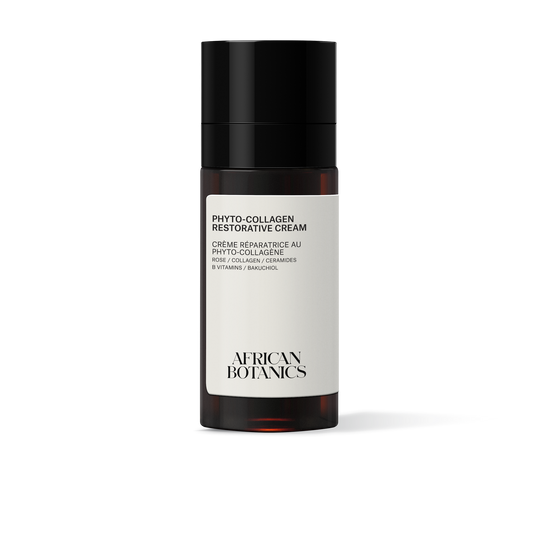
Phyto-Collagen Restorative Cream
Biotechnology-Derived Hydration / Visible Plumping
Not every formulation designed to improve the appearance of firmness relies primarily on signaling peptides.
Phyto-Collagen Restorative Cream introduces a complementary approach through a biotechnology-derived complex of encapsulated plant collagen and hyaluronic acid.
These materials are selected for their hydration and visible plumping properties, helping skin appear smoother, more cushioned and supple.
This distinction is scientifically important.
Topically applied collagen-derived materials should not be assumed to replace collagen within the dermis. Their cosmetic contribution may instead involve hydration, film formation and improvements in surface appearance, depending on their composition.
Combined with the cream's supporting lipid and botanical ingredients, the phyto-collagen complex illustrates how structural appearance can be addressed through moisture management and formulation design.
Discover Phyto-Collagen Restorative Cream
Beyond the Ingredient List
The Future of Precision Skincare
Peptide science is advancing alongside broader developments in biotechnology.
More sophisticated analytical methods are improving the characterization of molecular structures. Computational approaches are expanding the possibilities for identifying and designing peptide sequences. Delivery research continues to investigate how sensitive molecules can be incorporated into increasingly complex topical systems.
These developments are significant, but innovation should not be confused with clinical certainty.
The scientific evidence for cosmetic peptides varies substantially by molecule and formulation. While laboratory research has identified promising biological activities, controlled human studies remain limited for many topical peptide technologies.
This makes the quality of formulation research, the relevance of testing and the interpretation of results especially important.
For African Botanics, the future of advanced skincare lies in the considered integration of these disciplines: biotechnology, botanical science, barrier physiology and precise ingredient selection.
The most meaningful innovation is not necessarily the newest molecule or the longest ingredient list.
It is the development of formulations in which each technology has a defined purpose, supported by an understanding of the skin's biology.
Precision begins with the molecule. Its relevance is established by the science of the complete formulation.
Frequently Asked Questions
What Are Peptides in Skincare?
Peptides are chains of amino acids. Certain cosmetic peptides are developed or investigated for their potential interactions with biological processes associated with skin structure, hydration and the appearance of aging. Their functions depend on their individual molecular properties.
Do Peptides Stimulate Collagen Production?
Some peptides have demonstrated effects on collagen-related markers in laboratory studies. However, these findings do not establish that every peptide-containing skincare product increases collagen production in human skin. Clinical outcomes depend on the specific peptide, formulation and available evidence.
What Is the Difference Between a Peptide Serum and a Collagen Cream?
A peptide serum may contain defined sequences investigated for signaling-related functions. A collagen-containing cream may primarily support hydration, surface smoothness and visible plumping. The distinction depends on the actual ingredients and their formulation, rather than the product name.
Are More Peptides Better for Mature Skin?
Not necessarily. The number of peptides does not establish a formulation's quality or effectiveness. Peptide identity, concentration, stability, supporting ingredients and clinical evidence are more informative considerations.
Can Peptides Be Used With Vitamin C or Retinol?
Many peptide technologies can be incorporated into skincare routines alongside Vitamin C or retinoids. Compatibility depends on the specific products and formulations. Skin tolerance, particularly when introducing retinoids or other potentially irritating actives, should guide frequency of use.
What Is Peptide Encapsulation?
Encapsulation involves incorporating an ingredient into a carrier system, such as a lipid-based structure. It may be used to support stability or influence delivery characteristics. Its effectiveness must be demonstrated for the particular ingredient and finished formulation.
Scientific References & Further Reading
-
Nukaly, H. Y., et al. (2026). Oral and Topical Peptides for Skin Aging: Systematic Review and Meta-Analysis of Randomized Controlled Trials. Frontiers in Medicine, 13, 1618306. Read the study
-
Akaberi, S. M., Esfandiyari, M., & Ahmadi Ashtiani, H. R. (2026). Mechanistic Review of Topical Therapies Targeting Dermal Fibroblasts in Skin Aging and Rejuvenation. Journal of Cosmetic Dermatology, 25, e70987. Read the study
-
Naharro-Rodriguez, J., et al. (2025). Decoding Skin Aging: A Review of Mechanisms, Markers, and Modern Therapies. Cosmetics, 12(4), 144. Read the study
-
Feng, C., et al. (2024). Matrix Metalloproteinases on Skin Photoaging. Journal of Cosmetic Dermatology, 23(12), 3847–3862. Read the study
-
Birtles, T., et al. (2026). Bioactive Peptide Matrikines: Discovery Approaches for Skin Rejuvenation. American Journal of Physiology–Cell Physiology, 330(4), C974–C990. Read the study
