


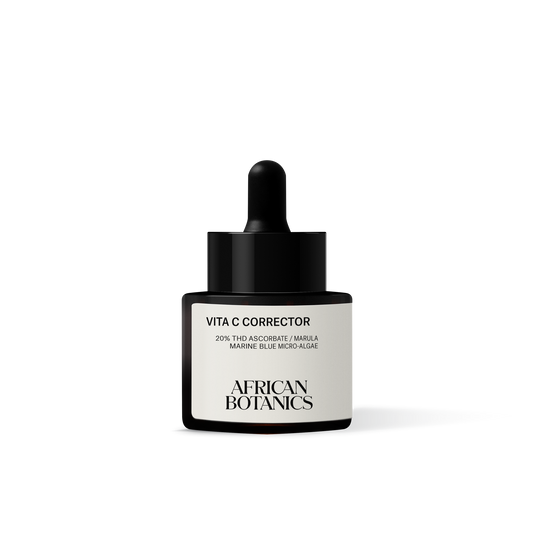
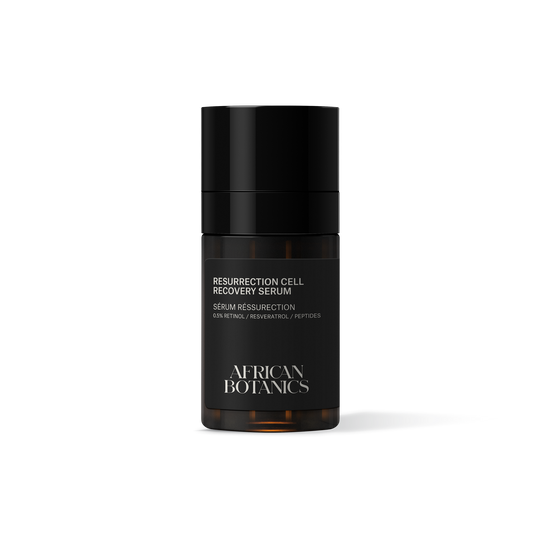


African Botanics Editorial · July 2026 · 8 min read.
The Cellular Biology of Summer
Skin keeps a record. Every interval of sun exposure — every afternoon spent at altitude, every walk along reflected water, every hour at a window — registers somewhere. In DNA strands. In mitochondrial fragments. In the structural proteins that hold the dermis together. The visible signs of photoaging that surface in a person's thirties and forties are not arrivals so much as disclosures. The damage has been accumulating quietly. The face simply catches up with the biology.
This is the premise underneath any serious approach to summer skincare, and where most of the category still gets it wrong. Sun protection is treated as a daytime variable — an SPF applied, an exposure managed. But the cellular events that produce photoaging are not contained within the hours of exposure. They unfold for days afterward, weeks afterward, sometimes longer. What skin does in July is what skin will reveal in November.

What Ultraviolet Light Actually Does to Skin
Two wavelengths matter most. UVB, the shorter band, is absorbed primarily in the epidermis, where it is taken up directly by DNA. The result is a specific class of lesion — most commonly cyclobutane pyrimidine dimers, in which adjacent pyrimidine bases bond covalently and distort the helix. Skin has repair machinery for these lesions — nucleotide excision repair, principally — but the system is imperfect. Some lesions persist. Those that persist in genes governing cellular proliferation form the substrate of skin cancer.
UVA, the longer band, penetrates further. It reaches the dermis, where it does its damage less directly. Photons are absorbed by chromophores already present in the skin — melanin, flavins, porphyrins — which then transfer that energy to molecular oxygen, generating reactive oxygen species: singlet oxygen, superoxide, hydroxyl radicals. These oxidise lipids in cell membranes, denature proteins, and damage mitochondrial DNA, which has a far less robust repair system than its nuclear counterpart.
This oxidative cascade initiates the second mechanism of photoaging: the upregulation of matrix metalloproteinases, particularly MMP-1, which cleaves type I collagen at specific peptide bonds. Repeated UVA exposure produces repeated cycles of collagen breakdown. The architecture of the dermis, slowly, gives way.
The Slow Arithmetic of Senescence
Cells that sustain un-repaired DNA damage have a choice to make. They can attempt repair. They can apoptose. Or they can enter senescence — a state of stable cell-cycle arrest in which they cease dividing but do not die. Senescent cells accumulate in photo-exposed skin throughout life. They are detectable by specific markers, including elevated p16INK4a, elevated p21, and the accumulation of lipofuscin granules, and they are now understood as a primary driver of visible aging.
The reason is that senescent cells do not sit inertly in tissue. They secrete. The senescence-associated secretory phenotype includes inflammatory cytokines, additional matrix metalloproteinases, and growth factors that disturb the behaviour of surrounding healthy cells. A single senescent fibroblast can degrade extracellular matrix in its immediate neighbourhood and signal adjacent cells toward dysfunction. Photoaging, in this sense, is not only the accumulation of damage but the propagation of it.
This is the biology underneath the colloquial understanding that the sun "adds up." It does, in the most literal sense. And it does so in tissues that lack the regenerative capacity to overwrite the record.

Lessons From a Plant That Should Not Exist
On the rocky outcrops of southern Africa grows a small woody shrub called Myrothamnus flabellifolius — the Resurrection Plant. Under drought stress, it loses up to 95% of its cellular water content. By every conventional metric of plant physiology, it should not survive. Yet on contact with rain, within hours, it rehydrates and resumes photosynthesis. The leaves unfurl. The organism returns to function.
The biology that permits this is instructive. Resurrection plants accumulate compatible solutes — sugars and small molecules that stabilize membranes and proteins as water disappears. They remodel their lipid bilayers to prevent fusion damage during desiccation. They produce extraordinarily high concentrations of polyphenolic antioxidants, including 3,4,5-tri-O-galloylquinic acid, a compound largely characteristic of this species, which scavenges reactive oxygen species generated when photosynthetic machinery is exposed to light without water to dissipate the energy. The plant has evolved, in other words, to survive an oxidative event that would destroy most organisms. It has done so under exactly the conditions — high UV, intense heat, prolonged stress — that produce photoaging in human skin.
This is more than analogy. The molecular pressures that shaped Myrothamnus are the same pressures that operate on a face exposed to sun. Reactive oxygen species are reactive oxygen species. Membrane peroxidation is membrane peroxidation.
The biochemistry is conserved across plant kingdoms. What differs is that the plant evolved its solutions over millions of years of selection in one of the most solar-extreme environments on the African continent. Skin did not.

What This Implies for the Architecture of Summer Skincare
The conventional summer protocol — a broad-spectrum sunscreen and perhaps an antioxidant serum — is necessary but not sufficient. If photoaging is the accumulation of oxidative events that continue to unfold for days after exposure, then summer skincare is properly understood as a continuous intervention rather than a daytime one. Three categories of action matter.
The first is genuine antioxidant capacity. Not the marketing version, but molecules in adequate concentration and stable form that can interrupt the ROS cascade before it propagates downstream. Stabilized vitamin C derivatives — tetrahexyldecyl ascorbate and ethylated ascorbic acid among them — penetrate the lipid stratum corneum more reliably than L-ascorbic acid and remain active at physiological pH, where conventional vitamin C formulas degrade. Polyphenolic compounds from plants adapted to high-UV environments contribute multivalent radical scavenging that water-soluble antioxidants alone cannot deliver.
The second is the support of repair. DNA repair enzymes continue working through the night. Mitochondrial turnover, lipid remodelling, and the clearance of damaged proteins all proceed during the sleep cycle. Retinaldehyde, the most direct biological precursor to retinoic acid, supports cellular turnover without the additional conversion step required of retinol. Peptide systems that signal toward collagen synthesis offset the daytime catabolism driven by matrix metalloproteinases.
The third is barrier integrity. A compromised barrier permits greater trans-epidermal water loss, greater inflammatory cytokine signalling, and greater downstream oxidative burden. Ceramides, fatty acids, and bio-fermented postbiotic actives restore the lipid lamellae that summer — through air conditioning, salt water, accumulated UV — repeatedly disturbs.
The Argument
Summer skin is not a problem to be managed at the surface. It is a record being written, daily, in the cells beneath. Myrothamnus flabellifolius did not evolve to look young. It evolved to survive a level of oxidative stress that would dismantle most living tissue. The principles that allow it to do so are the same principles that should organize any serious approach to skin in July.
The skin remembers everything. The intelligent response is to give the cells beneath the support they need.
FREQUENTLY ASKED
What does ultraviolet light actually do to skin at the cellular level?
UVB wavelengths are absorbed directly by DNA in the epidermis, producing lesions called cyclobutane pyrimidine dimers that distort the helix. UVA penetrates deeper into the dermis, where it generates reactive oxygen species that damage cell membranes, denature proteins, and trigger the breakdown of collagen through enzymes called matrix metalloproteinases.
What is cellular senescence in skin?
Cellular senescence is a state of stable cell-cycle arrest in which cells stop dividing but do not die. Senescent cells accumulate in sun-exposed skin throughout life and secrete inflammatory compounds that disturb surrounding healthy tissue. They are now recognised as a primary driver of visible aging in photo-exposed skin.
What is Myrothamnus flabellifolius?
Myrothamnus flabellifolius, known as the Resurrection Plant, is a small woody shrub native to the rocky outcrops of southern Africa. It can lose up to 95% of its cellular water content and fully revive on contact with rain. Its biology depends on extraordinarily high concentrations of polyphenolic antioxidants that have evolved to survive extreme UV and drought.
Why does photoaging continue after sun exposure ends?
The cellular events triggered by UV exposure unfold for days and weeks afterward. DNA repair, mitochondrial turnover, oxidative damage propagation, and collagen breakdown all continue after exposure ends. This is why summer skincare is properly understood as a continuous intervention rather than a daytime one.
Which ingredients support skin recovery from UV damage?
Stabilised vitamin C derivatives such as tetrahexyldecyl ascorbate and ethylated ascorbic acid interrupt oxidative cascades. Retinaldehyde supports cellular turnover. Peptide systems signal toward collagen synthesis. Ceramides and bio-fermented postbiotic actives restore the lipid barrier that summer environments repeatedly compromise.
REFERENCES
-
Cadet, J., Douki, T., & Ravanat, J. L. (2015). Oxidatively generated damage to cellular DNA by UVB and UVA radiation. Photochemistry and Photobiology, 91(1), 140–155.
-
Pfeifer, G. P. (2020). Mechanisms of UV-induced mutations and skin cancer. Genome Instability & Disease, 1, 99–113.
-
Pillai, S., Oresajo, C., & Hayward, J. (2005). Ultraviolet radiation and skin aging: roles of reactive oxygen species, inflammation and proteinases — a review. International Journal of Cosmetic Science, 27(1), 17–34.
-
Quan, T., Qin, Z., Xia, W., Shao, Y., Voorhees, J. J., & Fisher, G. J. (2009). Matrix-degrading metalloproteinases in photoaging. Journal of Investigative Dermatology Symposium Proceedings, 14(1), 20–24.
-
Wang, A. S., & Dreesen, O. (2018). Biomarkers of cellular senescence and skin aging. Frontiers in Genetics, 9, 247.
-
Csekes, E., & Račková, L. (2021). Skin aging, cellular senescence and natural polyphenols. International Journal of Molecular Sciences, 22(23), 12641.
-
Farrant, J. M., Cooper, K., Hilgart, A., Abdalla, K. O., Bentley, J., Thomson, J. A., Dace, H. J. W., Peton, N., Mundree, S. G., & Rafudeen, M. S. (2015). A molecular physiological review of vegetative desiccation tolerance in the resurrection plant Myrothamnus flabellifolius. Planta, 242(2), 407–426.
-
Moore, J. P., Westall, K. L., Ravenscroft, N., Farrant, J. M., Lindsey, G. G., & Brandt, W. F. (2005). The predominant polyphenol in the leaves of the resurrection plant Myrothamnus flabellifolius, 3,4,5-tri-O-galloylquinic acid, protects membranes against desiccation and free radical-induced oxidation. Biochemical Journal, 385(Pt 1), 301–308.
-
Pinnell, S. R. (2003). Cutaneous photodamage, oxidative stress, and topical antioxidant protection. Journal of the American Academy of Dermatology, 48(1), 1–19.
-
Mukherjee, S., Date, A., Patravale, V., Korting, H. C., Roeder, A., & Weindl, G. (2006). Retinoids in the treatment of skin aging: an overview of clinical efficacy and safety. Clinical Interventions in Aging, 1(4), 327–348.
