




The role of barrier lipids, moisture retention and lipid-rich formulations in maintaining skin comfort.
An Editorial Note / 6 minute read / November 2026

Dry skin is not always a question of insufficient moisture.
Skin can feel tight shortly after applying a hydrating serum or moisturizer. It may appear temporarily plumper, only to become dry again within hours. This is particularly common when humidity declines and indoor heating becomes more frequent.
The explanation lies partly in the distinction between supplying water to the skin and maintaining the barrier that helps retain it.
Hydration is essential. But it is only one part of the equation.
"The ability to retain moisture is as important as the moisture itself."
The Barrier Beneath the Surface
The stratum corneum, the outermost layer of the epidermis, is responsible for much of the skin's protective function.
Its structure is often described as flattened cells embedded within a lipid matrix. This matrix consists primarily of ceramides, cholesterol and free fatty acids, organized into tightly packed layers that regulate the movement of water through the skin.
When this organization is compromised, trans-epidermal water loss (TEWL) can increase. The skin may become rougher, less supple and more susceptible to irritation.
The effects are not necessarily dramatic. Persistent tightness, fine surface flaking or a moisturizer that seems to provide only temporary relief can all accompany inadequate barrier function.
The condition of the barrier also changes with age, environmental exposure and individual skin physiology.
Understanding these mechanisms helps explain why adding more hydrating products does not always resolve persistent dryness.
Hydration Is Not the Same as Moisture Retention
Humectants such as glycerin and hyaluronic acid bind water within the outer layers of the skin. They are valuable for improving hydration and the appearance of surface dehydration.
Lipids perform a different function.
Emollient ingredients help soften rough skin and improve its surface condition. Occlusive ingredients reduce water evaporation by forming a protective layer over the skin.
These functions frequently overlap within a finished formulation, but they are not interchangeable.
A water-based serum may improve hydration without providing sufficient emollient or occlusive care for very dry skin. Conversely, an oil can soften the skin without supplying the same water-binding properties as a humectant.
The most effective approach depends on the condition of the skin and the balance of ingredients within the formulation.
"Water replenishment and lipid nourishment are complementary functions. Neither should be considered in isolation."
Why Lipid Composition Matters
Ceramides account for a substantial proportion of the lipids in the stratum corneum. Alongside cholesterol and free fatty acids, they contribute to the highly organized structures responsible for limiting water loss.
Research has demonstrated that changes in epidermal lipid composition and organization can influence barrier integrity.
This is particularly relevant to dry and mature skin, where altered lipid profiles and reduced barrier efficiency may contribute to persistent discomfort.
In topical skincare, however, not all lipids behave identically.
The fatty-acid composition of a botanical oil influences its emollient characteristics. The presence of ceramides does not, by itself, determine the performance of a moisturizer. Concentration, ingredient compatibility and the overall formulation all matter.
A well-formulated moisturizer may combine water-binding ingredients, emollients and occlusive components to address several aspects of dryness simultaneously.
When Skin Requires More Than a Lightweight Moisturizer
Lightweight hydration may be sufficient for balanced skin. When dryness becomes persistent, however, additional emollient care can help restore comfort and improve the feel of rough, tight skin.
The choice is not simply between a serum and an oil, or between a moisturizer and a balm.
It is a question of what each formulation contributes.
A hydrating mist can provide a lightweight layer of moisture. An essence can introduce additional humectants and skin-conditioning ingredients. A facial oil can soften and condition the skin, while a concentrated balm may provide a more substantial protective finish.
Used selectively, these textures can complement one another without making a daily regimen unnecessarily complicated.
A Formulation-Led Approach
At African Botanics, hydration and lipid nourishment are addressed through distinct but complementary formulations.

Micro-Hydration Activator Mist introduces a lightweight hydrating step, formulated with an aquatic algae complex, baobab and niacinamide to support moisture and skin comfort.

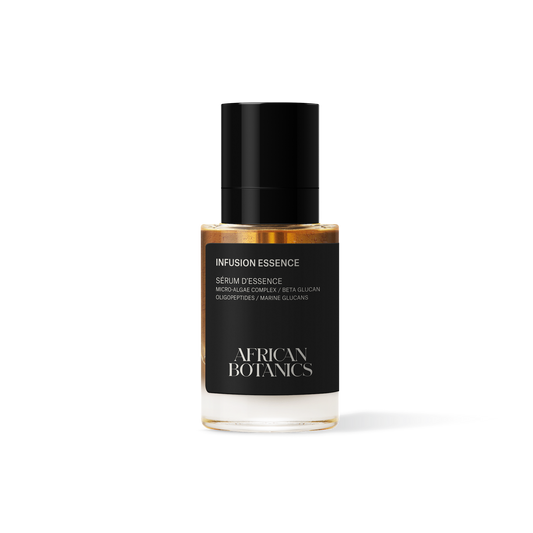
Infusion Essence combines micro-algae-derived ingredients, beta-glucan and oligopeptides in a concentrated essence designed to support hydration and the appearance of resilient skin.

Neroli Infused Marula Oil offers lipid-rich botanical care. Marula oil provides emollient fatty acids that help soften and condition dry skin.

Intense Skin Repair Balm provides a richer treatment texture for skin requiring additional nourishment and protection against moisture loss.
These are not four obligatory steps. They represent different formulation approaches that can be selected according to skin condition, climate and individual preference.

Beyond Hydration
Skin does not retain moisture through water-binding ingredients alone.
Its capacity to maintain hydration depends on the integrity of the stratum corneum, the organization of its lipids and the conditions to which it is exposed.
For persistently dry skin, understanding these relationships is more useful than simply increasing the number of products applied.
The objective is not maximum hydration at every step, but an appropriate balance between water replenishment, lipid nourishment and barrier support.
Explore the Formulations
MICRO-HYDRATION ACTIVATOR MIST
HYDRATING / PLUMPING / BALANCING
INFUSION ESSENCE
RENEWING / STRENGTHENING / REPLENISHING
NEROLI INFUSED MARULA OIL
NOURISHING / SOFTENING / BALANCING
INTENSE SKIN REPAIR BALM
NOURISHING / COMFORTING / PROTECTING
Frequently Asked Questions
Why does my skin feel dry even after moisturizing?
Persistent dryness may be associated with increased trans-epidermal water loss, environmental conditions or an impaired skin barrier. A moisturizer containing humectants, emollients and occlusive ingredients may provide more sustained comfort than a lightweight hydrating treatment alone.
What is the difference between hydration and lipid replenishment?
Hydration refers to water content within the skin. Lipid replenishment involves supplying emollient or barrier-supporting lipids that help condition the skin and, depending on the formulation, reduce moisture loss. Both functions contribute to skin comfort.
Should facial oil be applied before or after moisturizer?
Facial oils are commonly applied after water-based serums and may be used before, mixed with or after a moisturizer depending on the formulation. A few drops can provide additional emollient care without requiring a separate, elaborate regimen.
Is a balm better than a cream for very dry skin?
A balm may offer greater emollient or occlusive benefits when formulated with a high proportion of oils, waxes or other protective ingredients. The choice depends on the finished formulation and the skin's needs rather than the product category alone.
Scientific References & Further Reading
-
van Smeden J, Bouwstra JA. Stratum Corneum Lipids: Their Role for the Skin Barrier Function in Healthy Subjects and Atopic Dermatitis Patients. Current Problems in Dermatology. 2016;49:8–26. DOI: 10.1159/000441540.
-
Elias PM. Stratum Corneum Defensive Functions: An Integrated View. Journal of Investigative Dermatology. 2005;125(2):183–200. DOI: 10.1111/j.0022-202X.2005.23668.x.
-
Lodén M. The Clinical Benefit of Moisturizers. Journal of the European Academy of Dermatology and Venereology. 2005;19(6):672–688. DOI: 10.1111/j.1468-3083.2005.01326.x.
-
Proksch E, Brandner JM, Jensen JM. The Skin: An Indispensable Barrier. Experimental Dermatology. 2008;17(12):1063–1072. DOI: 10.1111/j.1600-0625.2008.00786.x.
-
Rawlings AV, Harding CR. Moisturization and Skin Barrier Function. Dermatologic Therapy. 2004;17(Suppl 1):43–48. DOI: 10.1111/j.1396-0296.2004.04S1005.x.
